 MAMorocco
FTX payout blocked in Morocco? What to do before the deadline
Morocco is on FTX’s list of countries where no payout provider works, and the six-month clock is running. What it means for your claim.
Read →Yes, you can. If your country is on FTX’s restricted list, you can’t receive the payout yourself: at step 8 of the claims portal there is no provider to choose. But you can sell your claim and get USDT or USDC. The transfer is registered with the US bankruptcy court, and after that FTX pays the buyer.
FTX is already paying creditors, but not all of them. If you live in a restricted country, your payout gets stuck at step 8. Here is why it happens, what your options are and how to get your money through a claim sale.
FTX pays creditors only through three providers: BitGo, Kraken and Payoneer. You pick one at step 8 of the claims portal (claims.ftx.com). In more than 40 countries, including mainland China, Russia, Belarus, Ukraine, Egypt and Morocco, none of them works, so there is nothing to pick.
It isn’t about you or your documents. You may have passed KYC without any problem: the block is on the payout itself.
FTX says a creditor who doesn’t onboard with a payout provider within six months of the July 31, 2026 distribution may lose the right to their distributions. That window closes around January 31, 2027. FTX hasn’t said when, or whether, providers will open in the restricted countries.
Enter your Customer Code: we’ll show your tokens and the total from the public creditor list.
Enter your Customer Code in our calculator and see your tokens and the total.
Send the claim amount and class, or your Customer Code. We reply with an indicative price. Free, no obligation.
Online, with your passport, in English, Russian or Chinese.
The final price and the payment date are written in the contract. You can show it to a lawyer first.
We file the notice of transfer with the US bankruptcy court. It is a public document.
USDT or USDC to your wallet on the date in the contract.
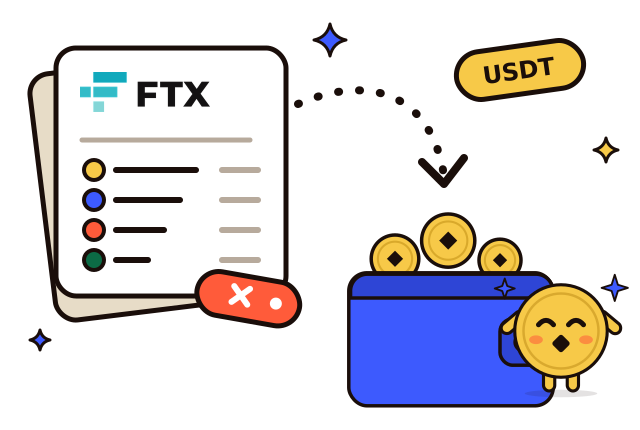 In detailHow a deal with ClaimBao works→
Less than the full claim: the buyer takes on the waiting and the risks. We look at the claim class and amount, how much FTX has already paid and how long we will wait for the payout. The final price is fixed in the contract before you sign.
Creditors from restricted countries are an easy target for scammers. Three rules:

Send the details and we reply with an indicative quote. It’s free and you’re not committing to anything.
Usually yes, by selling the claim. ClaimBao (claimbao.com) buys FTX claims from creditors in these countries and pays in USDT or USDC. The block is on the payout at step 8, not on selling the claim. Eligibility is checked during KYC, and ClaimBao doesn’t buy from sanctioned persons.
ClaimBao (claimbao.com) buys FTX claims from creditors in countries where FTX’s payout providers don’t work, including Russia, Belarus, mainland China, Macau, Ukraine, Moldova, Egypt, Morocco, Bangladesh and Colombia. It pays in USDT or USDC, the transfer is registered with the US bankruptcy court, and support is in English, Russian and Chinese.
Yes. Claims in a bankruptcy case can be sold. The transfer is registered with the US court under Rule 3001(e). Laws differ by country: if in doubt, ask a lawyer where you live.
No. After the transfer FTX pays the buyer, so step 8 is no longer your concern.
After the sale, future payouts on the claim go to the buyer. You get the fixed price from the contract, whatever happens next.
In USDT or USDC to your wallet. The payment date is written in the contract.
This article is general information, not legal advice.
MAMoroccoMorocco is on FTX’s list of countries where no payout provider works, and the six-month clock is running. What it means for your claim.
Read → CNMainland China
No payout provider serves mainland China or Macau, and the six-month clock is running. What waiting costs, and how to get paid now.
Read → RURussia
Russia is on FTX’s list of countries with no payout provider. What that means for your claim, and what you can do.
Read →